
Choosing a sofa layout for your Sydney home
Compare straight, modular and chaise sofas for your Sydney home. Use real product examples and a practical checklist to plan a Furver Auburn showroom visit.
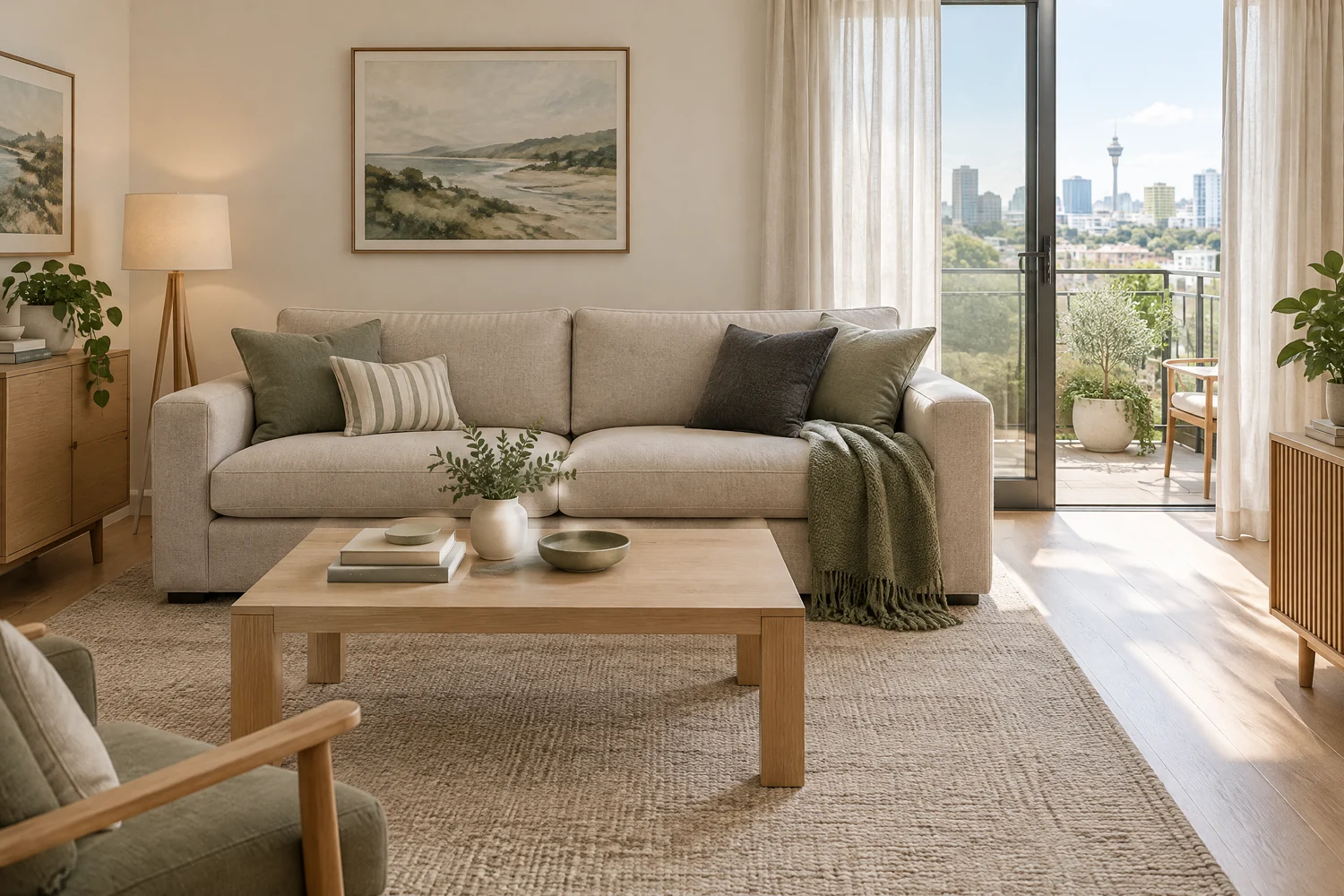
Quick answer — Count the seats you need on a normal evening, then sketch the paths between the entry, kitchen and balcony. If the chaise on your current sofa blocks the balcony door, mark out the new one on the floor and see if you can open the door and walk past comfortably. See FAQs.
Start with an ordinary evening
Count the people who use the living room most nights, then think about how they sit. A couple who both stretch out needs a different arrangement from a household of four who sit upright to watch television. The same number of advertised seats can serve those households very differently.
Think about the middle position as well as the ends. Does someone regularly sit there, or is it usually occupied by a throw and a laptop? If three people will use the sofa together, each needs a comfortable place for their shoulders, feet and a drink. A broad chaise does not automatically become an equally comfortable upright seat for a visitor.
Next, separate daily needs from occasional ones. If you host a large group twice a year, an armchair or occasional seating may solve that problem without making the everyday sofa dominate the room. In a smaller apartment, keeping the path to the kitchen open every evening is likely to matter more than fitting everyone on one couch at Christmas.
Write a short brief before browsing. For example: “Three people most evenings, one likes to stretch out, and we need a clear route to the balcony on the right.” That is specific enough to eliminate unsuitable couches while leaving plenty of choice in colour and style.
Match the shape to the room
A straight sofa creates a simple seating line. A chaise adds a place to stretch your legs. A corner arrangement turns the seating around the room, while a modular design describes how the pieces are made. These labels overlap, so compare the actual arrangement you can order.
| Arrangement | Useful when | The trade-off to weigh |
|---|---|---|
| Straight sofa | The room has a narrow living zone, several doorways or a separate armchair | Putting your feet up may require a movable footstool |
| Sofa with a chaise | One person regularly stretches out and the room has a clear side for the extension | The chaise occupies floor space even when nobody is using it |
| Reversible chaise sofa | You need to change the chaise side as the room or household changes | Reversing the chaise may require moving particular cushions or sections |
| Corner sofa | Several people gather in one defined seating zone | The corner position needs to work with people sitting beside it |
| Modular sofa | A verified combination of separate sections suits your layout | Some modules connect only in specified layouts |
A straight sofa when the walkway matters most
Picture a living room with a sliding balcony door beyond the television. An extended chaise across that route can become a daily annoyance. A straight sofa with a separate footstool gives you somewhere to stretch out while allowing the footstool to be moved for guests or access.
The Cortina Fabric Sofa is a useful Furver example for this arrangement. Its product page offers several sofa sizes and lists an ottoman as a separate selection. That lets you compare a seating-only arrangement with one that includes a movable footrest, rather than committing to a permanent chaise footprint.
Plan a home for the footstool when it is out of the way. Beside the sofa may work; parked in front of a cupboard usually will not. Include the separately selected ottoman in the order if it is part of your plan. Cortina’s standard listing states that an ottoman is not included with the sofa.
A chaise when stretching out is part of the routine
A chaise sofa makes sense when you can give its extension a place that leaves the main route through the room clear. It can also help define the edge of an open-plan living area without putting another tall piece of furniture across the view.
The Lucca Leather Sofa LHF lists both left- and right-facing options in its 3.5- and 4-seater selections. This makes it a relevant starting point when you want a leather chaise arrangement and already know which side should extend into the room. Compare the selected configuration with your plan; the product’s page title does not mean every available option faces left.
Try the chaise and the neighbouring seat together. If the person stretching out takes up the armrest or crowds the other person’s shoulder, the overall arrangement may need to change. Two good individual seats can be more useful than one very inviting lounging position.
A reversible chaise when the next layout is uncertain
Renters and households that rearrange furniture often have a practical reason to consider a reversible design. The Hudson 3.5 Seater Modular Sofa with Reversible Chaise is listed with that capability and an overall footprint of 290 × 180 cm. It belongs on a shortlist when you want a substantial fabric chaise arrangement with the option to change sides.
That footprint suits a room where you can give the chaise a generous place of its own. Changing sides can help you keep the balcony route open after rearranging the room, provided both layouts fit. Have the team confirm the exact pieces included in your chosen configuration before ordering.
Modular vs corner sofa is a question about two different things
A modular sofa is assembled from separate seating sections. A corner sofa describes a shape in which the seating turns a corner. One sofa can be both. The useful comparison is between the layouts available with the exact pieces you are buying.
A modular model may offer several configurations, or it may separate mainly for transport and assembly. An end section with a fixed arm cannot necessarily become a middle seat. Connectors may work only in specific positions. A chaise that arrives as a separate piece may still be designed for one side only.
If flexibility is the reason you are buying modular, draw the second arrangement you would actually use. Perhaps you want to split a long configuration into a sofa and a separate seat, or move the return to the other side after relocating. Ask for that specific arrangement to be demonstrated. “Can this be changed?” is much less useful than “Can these pieces make this layout?”
For a corner arrangement, test the corner seat with the seats either side occupied. Look at where everyone’s knees and feet go, then imagine a coffee table in front. An empty corner can look like useful extra seating even when the position will mainly be used for curling up alone.
There is no reason to choose modular if the flexibility will never be used. A straight sofa or a specified chaise configuration may give you exactly the seating you need, with fewer decisions about individual components. Choose the construction that supports your plan rather than treating the label as an automatic upgrade.
Put the chaise on the side that preserves the route
Trace the routes you use most: entrance to kitchen, sofa to balcony, dining table to hallway. Then place the chaise where it leaves those movements comfortable. Start with the route while someone is sitting on the sofa; their legs and a footstool take up space that an empty floor plan can miss.
A left-facing chaise sofa generally describes the extension on your left when you stand in front of the sofa and look towards it. Retailer labels and drawings still need to agree, so put an arrow on your room plan showing which way you are facing. Match the selected product photograph and configuration to that drawing before ordering.
That small step helps when two people are discussing the room from different viewpoints. “Left when sitting down” and “left when looking at the sofa” describe opposite sides. Sending the same marked-up plan to the retailer removes the ambiguity.
A reversible chaise can be useful if both positions work. It cannot rescue a layout where either position blocks the only sensible walkway. If the room is tight on both sides, return to a straight sofa and a movable footstool, or reduce the scale of the whole arrangement.
For the measurement method, including the complete footprint and delivery route, use our sofa dimensions and measuring guide. Settle the shape here, then use the measured plan to decide which size of that shape fits.
Compare real alternatives on the same basis
Several retailers offer a chaise that can change sides. The useful differences include how much room the arrangement occupies, how it changes configuration and the maintenance commitment of the selected upholstery. A smaller option may be the better choice even if you have room for something larger.
The examples below compare published layout information, checked on 21 November 2026. Width and depth describe overall furniture dimensions, not the clearance needed to walk around it. They are not comfort ratings.
| Model | Published layout facts | Why it may suit your room |
|---|---|---|
| Furver Hudson 3.5 Seater Modular Sofa with Reversible Chaise | Reversible chaise; 290 × 180 cm overall | A broader fabric arrangement for a living zone with room for a substantial chaise |
| Castlery Isaac Reversible Sectional Sofa | Chaise changes left to right; 218 × 165 cm overall | A narrower reversible option where the available wall length rules out a larger arrangement |
| LivingStyles Darryl Fabric Corner Sofa with Reversible Chaise in Charcoal | Reversible orientation; 208 × 150 cm overall | A compact chaise footprint when preserving floor space is the main requirement |
| IKEA KIVIK 3-seat sofa with chaise longue in Tibbleby beige/grey | Chaise can switch sides; 280 cm wide and up to 163 cm deep; removable washable cover | A broad seating arrangement for someone who wants a changeable chaise and published cover-care instructions |
Hudson gives you a larger overall footprint than the compact Isaac and Darryl examples. That can make it relevant to a more spacious living zone, but the extra centimetres are useful only if the seating and chaise feel right for your household. The smaller designs deserve a place on the shortlist when keeping a doorway or balcony route open is the harder problem.
Cortina offers another answer: choose a straight seating arrangement and move the separately selected ottoman when needed. Lucca is relevant when you prefer a specified leather chaise configuration and want to compare left- and right-facing options. The value in Furver’s range is the ability to shortlist these different arrangements around the same room brief, rather than trying to solve every room with one sofa shape.
Avoid comparing a fabric configuration with a leather version as though size were the only difference. Once you have chosen a layout, our leather vs fabric sofa guide explains what to consider about touch, care and everyday use.
Look at the room from the doorway
The sofa’s side and back may be the first things you see in an open-plan home. A model that looks balanced against a showroom wall can feel different when it sits between the dining and living areas.
Take a photograph from your entrance and another from the dining table. Use them to judge the height and outline of the sofa as well as its front view. A lower back may preserve a view across the room, while a taller back may help create a more enclosed seating area. Neither is automatically better; the effect depends on what you want to see and how supported you want to feel.
Work with the furniture that is staying. If you keep a substantial coffee table, allow it to influence the sofa choice. If the dining chairs already need to pull back into the living zone, a return or chaise may create more of an obstacle than the room photograph suggests.
Colour can wait until those relationships make sense. It is easier to change a cushion than to change the route to the kitchen.
Make an Auburn showroom visit answer the remaining questions
If you are comparing sofa shops in Auburn, bring the same short brief to each visit. Include room measurements, photographs, the location of doors and a clear note of the chaise side. Save the model names and configuration you shortlisted so you can compare like with like later.
For shoppers looking for sofas in Western Sydney, Furver’s contact page is the starting point for a visit to LINSY by Furver at Shop B3, Level 1, Auburn Megamall, 265 Parramatta Road, Auburn NSW 2144. Confirm that the models and sizes you want to try are available to view before travelling.
Sit as you would at home. Lean back, move to the middle seat, stretch out if that is how you relax, and get up again. If two people will share the sofa every evening, try it together. A quick sit on the easiest end seat does not tell you how the whole arrangement works.
Ask to see the configuration change if that feature matters. Watch what moves, where the cushions go and whether the arrangement uses the same pieces. Record the exact size and upholstery you tried. Your photograph should help you identify the model afterwards, rather than become the only record of what you ordered.
Finally, bring up delivery access before making the decision. A modular design may break into smaller sections, but the actual package or component sizes still have to suit your doorway, lift and stair turns. A room plan and an access plan answer different questions, and you need both.
Once your shortlist meets the room brief, compare the complete order cost using our sofa prices and sale buying guide. The right next step is the model that works for an ordinary evening, fits the routes through the room and makes sense at the total price you will pay.
Questions that often come up after the shortlist
Can I add extra modules in a few years?
Only if compatible pieces remain available. Ranges, connector designs and upholstery options can change. If another section is essential to a layout you already intend to use, include that requirement in the current decision. Treat possible future additions as a benefit rather than a promise.
Does every seat need to be on the same sofa?
No. A sofa and a separate armchair can make conversation easier and give two people different seating preferences somewhere to sit. It may also leave more routes through the room. Compare the combined footprint of both pieces, including the space used when the chair is occupied.
Should I keep the sofa against the wall?
Only if that position makes the room work. Moving it forward can define the living zone in an open-plan space, but it also creates a route behind the sofa that needs usable space. Try the position with floor tape before moving other furniture or ordering a larger model.
Can I make a sensible choice entirely online?
Yes, if the dimensions, configuration and upholstery information answer your needs clearly. An in-person visit is most useful when comfort or an unfamiliar mechanism is still uncertain. Send a marked-up room plan and a list of specific questions rather than trying to judge scale from a styled photograph alone.